

'They are positioned as defensive products and can potentially give marginally higher returns than liquid funds.'

Reserve Bank Governor D Subbarao will, however, not touch the policy rate or the repo, rate at which RBI lends to banks, on October 30 when he unveils the half-yearly monetary policy because headline inflation continues to be elevated at 7-7.5 per cent, the agency said.

India Inc, which is sitting on cash balances of 13.5 trillion, is using the funds to meet capital expenditure as well as brownfield expansion, resulting in 'anaemic' demand for bank loans, State Bank of India (SBI) chairman CS Setty said at an event on Monday. He added that a slowdown in corporate credit is mainly due to lack of demand.
The Reserve Bank of India has raised the cash reserve ratio of banks by 0.5 per cent to 5 per cent of their net demand and time liabilities (NDTL), in two stages beginning fortnight September 18.
The key short-term lending rate (repo rate)has been hiked by 0.25 pc to 7.50 pc.
Concerned over surging inflation, Reserve Bank of India hiked the short-term repo rate on Wednesday by 0.25 per cent to 7.50 per cent while keeping reverse repo, bank rate and cash reserve ratio unchanged.
The principles of central banking in Asia are likely to change. Be prepared for surprises.
In a late Tuesday evening development, RBI raised the repo rate, or the rate at which it lends to banks, by 50 basis points to 8.50 per cent. The cash reserve ratio, or the proportion of deposits kept with the central bank, will be increased by 50 basis points to 8.75 per cent.

Hike in CRR to suck out Rs 12,500 crore from the banking system.

At its monetary review on Tuesday, the RBI raised the statutory liquidity ratio by 1 percentage point to 25 per cent and discontinued the special repo facility for banks to provide liquidity to mutual funds and others.

Mint Road's proposals on banks' M&A funding are cautious even as entrants root for more elbow room, and weigh business models.

The global brokerage firm believes that CRR cut is likely to help cut lending rates and revive growth sentiments.
The Reserve Bank of India on Tuesday hiked the cash reserve ratio by 25 basis points.

The RBI is likely to raise CRR, the portion of funds that banks have to keep with the regulator, by 50 basis points in its forthcoming monetary review next week and signal tight monetary measures, says Moody's.

Net profit of 19 listed banks is likely to decline by 4 per cent year-on-year (Y-o-Y) for the quarter ended March (Q4FY25) mainly due to pressure on net interest margins (NIM) as a result of rate cut by the Reserve Bank of India (RBI), according to analysts' estimates. Additionally, loan growth is expected to further slowdown amid low demand in certain secured products, stress in the unsecured segment, and a high cost to deposit (CD) ratio across the system.

The RBI under former governor Shaktikanta Das resisted pressures to cut interest rates through 2024 as it kept its 'Arjuna's eye' trained on inflation, but the central bank under a new detail-oriented head will soon have to take a call if it can continue sacrificing growth. Das, a career bureaucrat who in 2016 oversaw Prime Minister Narendra Modi's highly disruptive demonetisation move, left a lasting legacy as he demitted office towards the end of 2024 after expertly navigating monetary policy for six years, the highlight of which was steering India's recovery through the pandemic.

The government has introduced friendly policies for the infra sector

Short-term lending rate unchanged at 7.75 pc.

The use of RBI capital to strengthen public sector banks will have many positive implications for the economy -- and a few manageable downsides, points out R Jagannathan.
The Reserve Bank of India on Tuesday cut the bank rate by 0.25 per cent to 6 per cent with effect from close of business hours.

Foreign investors have made a strong comeback to Indian equities with a net investment of Rs 22,766 crore in the first two weeks of December driven by expectations of rate cut by the US Federal Reserve. This revival follows significant outflows in the preceding months, with Foreign Portfolio Investors (FPIs) pulling out a net Rs 21,612 crore in November and a massive Rs 94,017 crore in October -- the worst monthly outflow on record.

The central bank was widely expected to maintain status quo.

Importers are rushing to hedge their dollar positions amid the sharp depreciation of the rupee against the American currency and expectations of further volatility even as exporters are holding off after suffering mark-to-market (MTM) losses on earlier hedges.

After hiking the repo rate by 0.50 per cent, RBI Governor Shaktikanta Das on Wednesday said future policy actions by the central bank will be guided by the evolving conditions. Addressing a press conference, the governor said the RBI has changed the policy stance to drop the phrase "remains accommodative", and instead opted for "withdrawal of accommodation" for guiding its future moves. The central bank did not hike the cash reserve ratio contrary to speculation, he said, adding that the liquidity withdrawal will be calibrated and measured.
RBI will be cautious easing rates further given oil price uncertainties
.jpg)
SBI Chairman in the last year's banking conclave had started a debate by seeking to abolish cash reserve ratio to enhance liquidity in the banking sector for more productive use.

Housing demand should improve nationwide after the Reserve Bank of India (RBI) cut the repo rate by a larger-than-expected 50 basis points (bps) on Friday, said real estate industry executives. The rate cut comes after housing sales in top Indian cities in the first quarter of 2025 dipped 28 per cent due to skyrocketing residential property prices and geopolitical headwinds, according to Anarock.

The Reserve Bank of India has kept the key short term lending rate (repo rate) unchanged at 7.25%.


Next bi-monthly policy statement on September 30.

Highlights of RBI's third quarter review of monetary policy.

'There are occasions when the prices of individual items like food raise inflation; then supply-side measures must be taken.' 'But if there is continued inflation, it means liquidity is aggravating the situation.'
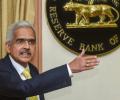
Financial markets are under stress and require steps by the central bank for market stability and revival of economic growth, he said while announcing the decisions taken by the Monetary Policy Committee in Mumbai.

Infrastructure bond issuances by commercial banks in the current financial year (FY25) are likely to surpass Rs 1 trillion, almost double that of FY24, market participants said. So far this financial year, banks have raised Rs 74,256 crore via infra bonds. In FY24, the total issuances stood at around Rs 51,081 crore.

The central bank kept cash reserve ratio unchanged at 4 per cent.

Benchmark policy rate unchanged at 6.75 per cent.

Showing concerns over hardening inflation, the Reserve Bank today left the key interest rate unchanged but reduced cash reserve ratio by 0.25 per cent to inject Rs 17,500 crore (Rs 175 billion) liquidity into the financial system.
